Sunday, August 14, 2011

Just to Get Everyone in the Spirit

The Radetzky March

He was only called Pfiffikus because you give that name to someone who likes to whistle, which Pfiffikus most definitely did. He was constantly whistling a tune called the "Radetzky March," and all the kids in the town would call out to him and duplicate that tune. (Page 52)

The "Radetzky March" was written by Johan Strauss Sr. in 1848 (Op. 228) and dedicated to the Austrian Field Marshal Joseph Radetzky von Radetz. It is traditionally played as the final number at New Year's concerts in Vienna. The audience claps in time to the music. The video below shows the "Radetzky March" being played at the 1987 New Year's concert in Vienna with Herbert von Karajan conducting the Vienna Philharmonic and the audience.

Saturday, August 6, 2011

August Meeting Wrap-Up

For those of you who came here looking for the post with the nominees that weren't chosen during the last selection, since I have a feeling that post is about to be knocked off the bottom of the page by this post, here is a permalink to that post. You will find synopses both for the books that weren't chosen and the books which were chosen, so out of those, the ones we are being asked to consider now for voting by e-mail are:
A Visit from the Goon Squad by Jennifer Egan
Just Kids by Patti Smith
Parrot and Olivier in America by Peter Carey
Let the Great World Spin by Colum McCann
Half Broke Horses by Jeannette Wells
Mr. Pip by Lloyd James

I just realized that Let the Great World Spin is not in the original post because it was nominated at the meeting and not before, so here is a link to a synopsis of that. Also, we have a nomination by Nancy for consideration of Room by Emma Donoghue, so here is a link for that. Peggy would like to have us pick our 4 favorites and reply no later than Sunday, August, 21, 2011, by email or by phone. I don't want to post her email and phone here on the internet (for anti-spam reasons), but if you don't have them, add a comment to this post stating so, and I will send them to you.

Followup to City of Thieves: A Russian Movie Recommendation, "Ballad of a Soldier"


For those of you who don't mind subtitled movies, a Russian movie from 1959 that you might enjoy is "Ballad of a Soldier." It is available on Netflix and is not as "heavy" as a lot of Russian movies, also the hero of that story physically looks what I imagine the character "Kolya" to look like. In the movie, the hero's name is "Alyosha," (diminutive of Alexei). He is out on recon one day at the front, and he and his partner stumble across German tanks. Impulsively and in a panic, Alyosha picks up an anti-tank gun and scores a direct hit on two tanks, incapacitating them. For his "bravery," his commanding officer proposes him for a medal. Alyosha asks instead for leave for a couple of days to visit his mother on the collective farm because her roof has been leaking and he wants to repair the roof. The officer agrees, but since he knows travel in wartime will be difficult, he grants Alyosha 6 days: 2 days to get there, 2 days to fix the roof, and 2 days to get back. The film then follows Alyosha on his journey where: 1) transportation is even more messed up than his commanding officer imagined, and 2) Alyosha is such a friendly and helpful guy he can't help getting involved in the lives of the people he meets along the way. That is all I can say about the plot in case any of you want to watch it.

Wednesday, August 3, 2011

Saturday, August 6, 2011, at 2 p.m.

City of Thieves by David Benioff

The siege of Leningrad


The encirclement of Leningrad by the German army was completed on September 8, 1941, and was not completely lifted until January 27, 1944. By the time it was over, of the original 3 million residents of the city, anywhere from 600,000 to 800,000 had died of cold, starvation, or bombardment by the Germans (not to mention being shot by the authorities for looting, desertion, etc). The picture and the facts are lifted from the St. Petersburg tourism web page Another good site I found was part of an "Eyewitness to History" site and contains several survivor accounts in their own words.

Cultural References from City of Thieves (I look them up so you don't have to.)

War and Peace. On page 90, Kolya expresses his opinion about Natasha Rostov, the main female character from Tolstoy's War and Peace, causing Lev to marvel that anyone would care that much about a fictitious character. What I found out by watching the David Benioff video that I have embedded below is that, during the siege, copies of War and Peace were printed up and handed out to the people of Leningrad to read as a morale booster.

Osip Mandelstam (1891–1938). (I can't find the exact page for reference). A Russian poet of Polish Jewish extraction, Mandelstam grew up in imperial St. Petersburg, and like most poets of the time, was initially a supporter of the revolution. Like the father of the main character, Lev, he was seized by the police and died in custody. Benioff references Mandelstam's "Stalin Epigram."
The Stalin Epigram
by Osip Mandelstam
translated by W. S. Merwin

Our lives no longer feel ground under them.
At ten paces you can’t hear our words.

But whenever there’s a snatch of talk
it turns to the Kremlin mountaineer,

the ten thick worms his fingers,
his words like measures of weight,

the huge laughing cockroaches on his top lip,
the glitter of his boot-rims.

Ringed with a scum of chicken-necked bosses
he toys with the tributes of half-men.

One whistles, another meows, a third snivels.
He pokes out his finger and he alone goes boom.

He forges decrees in a line like horseshoes,
One for the groin, one the forehead, temple, eye.

He rolls the executions on his tongue like berries.
He wishes he could hug them like big friends from home.

Anna Akhmatova (1889–1966). A Russian poet of upper-class Russian extraction and a great friend of Osip Mandelstam. (Some, including Mandelstam's wife, claimed that the two were more than friends, but Akmatova always denied it.) Akhmatova also initially supported the revolution but eventually became disillusioned. She was often criticized by the Soviet establishment for writing bourgeois, sentimental love poetry. Because of her personal associations, her poetry was officially banned between 1925 and 1940. On page 68, Kolya lashes out at Akhmatova, not only for her "narcissistic" verse, but also for having left Leningrad and for urging the women of Leningrad to fight via radio broadcast from the safety of Tashkent, Uzbekistan.

Dmitri Shostakovich (1906–1975). The composer remained initially remained in Leningrad where he volunteered for the fire brigade and posed for the posters mentioned by Lev on page 67. He wrote the first three movements of his 7th Symphony while in Leningrad, but was evacuated to Kuybishev where he finished the work (it turns out Kolya was right about that). The 7th Symphony is often called the "Leningrad Symphony," and was premiered in Moscow, but the most famous performance was in wartime Leningrad itself as detailed in the video clip below.


Interview with David Benioff about City of Thieves


Part 1


Part 2


Part 3

Friday, July 8, 2011

Saturday, July 9, 2011, at 2 p.m.

Major Pettigrew's Last Stand by Helen Simonson

Get yer anglophile on! Helen Simonson talks about her book.

Saturday, May 28, 2011

Saturday, June 4, 2011, at 2 p.m.

Cutting for Stone by Abraham Verghese

Abraham Verghese. There is some brief biography at the front of the book, but also I found his website, where you can find out more about the man himself and his books and articles. From the website:
Born of Indian parents who were teachers in Ethiopia, he grew up near Addis Ababa and began his medical training there. When Emperor Haile Selassie was deposed, he briefly joined his parents who had moved to the United States, and worked as an orderly before returning to complete his medical education at Madras Medical College. he later retured to the U.S. for his residency as one of many foreign medical graduates. Like many other foreign medical graduates, he found only the less popular hospitals and communities open to him, an experience he described in one of his early New Yorker articles, The Cowpath to America.

From Johnson City, Tennessee, where he was a resident from 1980 to 1983, he did his fellowship at Boston University School of Medicine, working at Boston City Hospital for two years. It was here that he first saw the early signs of the HIV epidemic and later, when he returned to Johnson City as an assistant professor of medicine, he saw the second epidemic, rural AIDS, and his life took the turn for which he is most well known -- his caring for numerous AIDS patients in an era when little could be done and helping them through their early and painful deaths was often the most a physician could do.

What does "cutting for stone" mean? I had to look up the origin of the phrase "cutting for stone," because it was obvious in the novel and from the various contexts in which it was used, that it had some cultural reference outside of the novel itself. It turns out that it is from the Hippocratic Oath, "I will not cut for stone, even in patients in whom the disease is manifest..." which is widely interpreted as drawing a distinction between being a physician and being a surgeon and a proscription against a physician performing procedures for which he is not qualified, even if it seems like easy money.


Ethiopia and Eritrea

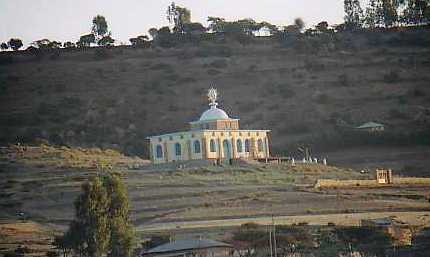
Those of us at the meeting last month, who had already started Cutting for Stone remarked about what a fascinating place Ethiopia sounded like, so I rounded up some pictures from the internet.

Addis Ababa: The modern capital of Ethiopia, the setting of much of the novel, and the city of Marion Stone's (and Dr. Verghese's) youth.


Axum: The ancient capital of Ethopia and the location of the treasury which houses what is claimed to be the original Ark of the Covenant. The first picture is the old St. Mary's church. The subsequent pictures are from in or near the new St. Mary's church (built by Haile Selassie). The last picture is of the treasury.


Lalibela:
This is the site of ancient churches carved from the surrounding rock hills. The last picture is the largest church in the world carved out of a single piece of stone.


Eritrea:
Now a sovereign nation, in the novel it was part of Ethiopia, the homeland of Rosina and Genet, and the country of rebels.


Tizita (see pages 227 and 228):
This is the song that Almaz sang as young Marion held her breast. It is the song that is synonymous with Ethiopia to the older Marion as he is living in the United States. As it says in the book, there are many versions. This is my favorite of the versions I found on YouTube.

Friday, May 6, 2011

You Know, I Don't Remember the 80's at All

For those of you who came looking for the book suggestions we're going to vote on Saturday, they're in the post down below.

Otherwise, it's time the get your 80’s groove on (via Sag Harbor).

First, pull on your Cosby sweater...
People we knew started wearing sweaters with mind-melting patterns, in tribute to the Coz Himself, and the barber shops buzzed up versions of Theo’s latest haircut, whatever he and his friends sported on set, in their brief careers, those handsome boys who went nowhere. The young men marched out of barbershops to all coordinates with flattops, fades, hi-tops of Pisan ambition: Theo’s army. “They’re a real Cosby Family,” people said, when acquaintances broke the atmosphere to better orbit. A term of affection and admiration. Page 193


...I walked in just in time to hear the newscaster say, “A surprising announcement about an American classic.” Somehow I knew. I stayed through the commercial break and watched as Roberto Goizueta, the CEO of Coca-Cola, cheered the end of the world. It was inconceivable, like tampering with the laws of nature. Hey, let’s try Gravity-Free Tuesdays, buckle up, motherfuckers. From this day on, water is incredibly flammable, see how that goes... Page 127

You Cha-Ka lookin’...

You could also preface things with a throat-clearing “You fuckin’,” as in “You fuckin’ Cha-Ka from Land of the Lost–lookin’ motherfucker,” directed at Bobby, for example, who had light brown skin, light brown hair, and indeed, shared these characteristics with the hominid sidekick on the Saturday morning adventure show Land of the Lost. Page 52


Here We Go...


Bobby turned on his MC voice, “One Two Three, in the place to be,” and Reggie said, “Alright!” They started their routine and I rolled my eyes in the darkness. Bobby and my brother had memorized the lyrics to Run-D.M.C.’s “Here We Go” and had to perform it at least ten times a day. Page 169


The highlight of the summer was the U.T.F.O.– Lisa Lisa concert...


Lisa Lisa was shorter in person, but her chest was bigger. I signed off on that. Page 253


U.T.F.O. (Un Touchable Force Organization) represented teen striving, youthful perseverance against the odds, and goofball personas that made our own stabs at reinvention look like genius. Page 235


Everybody Hated WLNG...


...All I could do was succumb to the LNG Effect. It proceeded thusly: out of the speakers emerged a song you’d heard only once before in your life, one that left such a faint record in your brain that it was a memory of a memory. Paralyzed by confusion, you wondered, “Where have I heard that before?” The answer was, Nowhere important. Page 269.