Wednesday, July 30, 2014

Saturday, August 2, 2014, 2:00 PM, San Leandro Main Library

My Beloved World by Sonia Sotomayor


Please note that this discussion is to take place on August 2, not August 9. Jean will be leading the discussion of Justice Sotomayor's memoirs.


Tuesday, July 8, 2014

Saturday, July 12, 2014, 2 PM, San Leandro Main Library

Dear Life by Alice Munro

I'm feeling lazy this month, so I'm just going to lift Alice Munro's biography wholesale from the Biography.com website:

Synopsis

Born in Canada in 1931, writer Alice Munro, primarily known for her short stories, attended the University of Western Ontario. Her first collection of stories was published as Dance of the Happy Shades. In 2009, Munro won the Man Booker International Prize. That same year, she published the short-story collection Too Much Happiness. In 2013, at age 82, Munro was awarded the 2013 Nobel Prize in Literature.

Early Life and Career

Alice Munro was born Alice Ann Laidlaw on July 10, 1931, in Wingham, Ontario, Canada. She attended the University of Western Ontario, where she studied journalism and English, but left the school after only two years when she married first husband James Munro (m. 1951–1972); the couple moved to Victoria, Vancouver, British Columbia, where they opened a bookstore. Also during this time, Munro began publishing her work in various magazines.

Munro's first collection of stories (and first book-length work) was published in 1968 as Dance of the Happy Shades; the collection achieved great success in Munro's native country, including her first Governor General's Award for fiction. Three years later, she published Lives of Girls and Women, a collection of stories that critics deemed a Bildungsroman—a work centering on the main character's moral and psychological development.
Continued Success

Primarily known for her short stories about life in Ontario, Munro has published several collections over the past several decades, including Who Do You Think You Are? (1978); The Moons of Jupiter (1982); Hateship, Friendship, Courtship, Loveship, Marriage (2001), which was later adapted into a film, "Away from Her," directed by Sarah Polley and released in 2006; Runaway (2004); and The View from Castle Rock (2006).

Munro received her second Governor award exactly three decades after her first, in 1998, for The Progress of Love. In 2005, TIME magazine named Munro a TIME 100 Honoree. "Alice Munro is 73 now, and she deserves the Nobel Prize," TIME wrote. "Her fiction admits readers to a more intimate knowledge and respect for what they already possess."

In 2009, Munro won the Man Booker International Prize, honoring her lifetime body of work. That same year, she published the short-story collection Too Much Happiness.

Munro would go on to publish 13 short-story collections by her 80th birthday. Most recently, in 2012, she published Dear Life—her final story collection, according to the writer, who announced that she was retiring from writing in June 2013.

In 2013, Alice Munro won the Nobel Prize for literature. Here is here official Nobel Prize interview:

Thursday, June 5, 2014

Saturday, June 7, 2014, 2:00 PM, San Leandro Main Library

Telegraph Avenue by Michael Chabon

Set in "Brokeland," the area where Oakland merges into Berkeley, Telegraph Avenue is the story of two families. The men, Nat and Archy, are partners in a used record store in Oakland, while the women, Aviva and Gwen, are partners in a midwife clinic in Berkeley. Below is a video of a Los Angeles Times interview with the author. The interview was carried out via Skype, so the quality isn't the greatest, and it is more than 30 minutes long, so you need to carve yourself out some listening time if you are interested. However, it was more informative than the other author interviews available on YouTube.


Echos of the 70s

Although Telegraph Avenue is set in 2004, there is much in the way of references to the 1970s, including a crime carried out in 1973 that has significance for the present and a whole cast of characters who in some way or another are stuck in the 70s. Some of the cultural references include:


Leisure Suits

A pattern so you can create your own.
Archy's surrogate father, musician Cochise Jones, has a cherished collection of leisure suits. If I remember correctly from my own impressions of the 70s, the actual length of time that leisure suits were in fashion was fairly short, but that particular garment is still used as shorthand to define the style of the era.
Azetec pattern fabric

Muscle Cars

Olds Toronado
When the book referred to Luther Stallings' Toronado (Oldsmobile), I had a mental picture of the car from "Starsky and Hutch," but that was a Torino (Ford). See the difference?
Ford Gran Torino

Soul/Funk/Jazz Fusion Music

Archy and Nat's store, Brokeland Records, specializes in vintage vinyl from the 70'.


Grover Washington, Jr., was one of the patron saints of Brokeland Records.


Minnie Riperton reminded Archy of his dead mother and was also the name of Gibson Goode's zeppelin.

Blaxploitation Movies

Due to the rising awareness in the 1970s of the entertainment industry's lack of opportunities for African American actors, Hollywood was quick to cash in. Starting with "Shaft," audiences were treated to a number of movies, mostly action movies, with a black primary star. In Telegraph Avenue, Valletta Moore, the long-time girlfriend and former co-star of Luther Stallings (Archy's mostly absentee father), had posed for an iconic poster, which I believe was probably based on this poster for the Pam Grier vehicle, "Coffy."

Kung-Fu Movies and "Black-Fu" Movies

As mentioned in the book, Bruce Lee had his first kung-fu studio in Oakland. Here is an advertising poster for the school.

Here is a short clip of Bruce Lee's widow telling an interesting anecdote about his Oakland school.


Film nerds review their favorite scenes from Bruce Lee's martial arts movies.


This is the intro from "Black Belt Jones," starring Jim Kelly, the first African American martial arts movie star. Kelly had made his first acting appearance in Bruce Lee's best known film, "Enter the Dragon," and appeared later in a series of martial arts movies and other movies. Kelly died a little over a year ago. In Telegraph Avenue, Luther Stallings was said to have been better than Jim Kelly.


Echos of Echos of the 70s

The sons of the two families, Julie Jaffe, Nat and Aviva's son, and Titus Joyner, Archy Stallings' only recently acknowledged son, are big fans of the movies of Quentin Tarantino.  Tarantino grew up in the 70s, and his movies are full of 1970s pop cultural references, particularly the crime drama "Pulp Fiction," and the martial arts revenge movie "Kill Bill." One of my favorite Tarantino movies is "Jackie Brown," a 1997 movie based on an Elmore Leonard novel and starring Pam Grier of iconic poster fame. In the clip below, Grier and her co-star, Robert Forster, have a discussion about the merits of LPs versus CDs.


Thursday, May 1, 2014

Saturday, May 3, 2014, 2:00 PM, San Leandro Main Library

Wild: From Lost to Found on the Pacific Crest Trail by Cheryl Strayed

Cheryl Strayed was born in 1968 in Pennsylvania, and much of her biography was referred to in Wild, how her family moved to Minnesota when she was 5, how her mother divorced her abusive father and later married her hippie handyman stepfather and the family moved to the extreme boonies of Minnesota to live on a 40-acre in a hand-built house without electricity or running water. In Wikipedia, it also mentions that the young Cheryl was a track and cross-country runner as well as a cheerleader and homecoming queen. Knowing Wikipedia, this may or may not be true, but it fits my prejudices, so I'm going to go with it.

In the book, she details how her mother's diagnosis of lung cancer and subsequent rapid deterioration and death, which happened during Cheryl's senior year of college. This was the central crisis of her young life, which sent her into a self-destructive spiral which culminated in her sudden decision to put her life on hold and spend a summer hiking the Pacific Crest Trail, the hike which forms the backbone of her memoir. I borrowed the two videos below from her official web site.


From 2010 to 2012, Cheryl Strayed also had another identity as "Dear Sugar," the advice columnist for "The Rumpus," which is an online literary magazine. Strayed revealed her secret identity in 2012 about the time that Wild was published.


A Scenic Tour of the Pacific Crest Trail 

Tehachapi Pass


This is where Cheryl Strayed began her trek.

Kennedy Meadows


This is the "gateway to the high Sierras," the place where Strayed picked up her first resupply box, was given lessons in lightening her pack and using an ice axe, and shortly after which she decided to bypass the high Sierras because of snow.

Sierra City


This is where she got back on the trail.

Belden Town

This is Mt. Lassen, the volcanic peak that Strayed describes as being visible from the trail as she neared Belden Town and her second supply box. It was on the stretch of trail right before Belden that she received her Bob Marley t-shirt from Paco the firefighter, and it was in Belden that she waited in vain for her new boots (a size larger) to arrive from REI. 

Burney Falls to Castle Crags


It was near Burney Falls that Cheryl lost one of her old, too small hiking boots down the side of a ravine and threw the other over after it. She was forced to make the next leg of the hike in sandals and duct tape until she arrived at Castle Crags where her new (one size larger) boots were waiting.

On a personal note, Castle Crags was just a few miles from the campground where I used to attend summer camp and youth retreats as a teenager. We had a great view of Mt. Shasta from there, as did Cheryl Strayed from the Pacific Crest Trail.


Seiad Meadows (near the Oregon border)


This is near where Cheryl met Miriam, Kyle, and "Shooting Star," the llama.

Ashland, Oregon


Lovely city in which Strayed took a break from hiking and got to have sex for the first time in weeks.

Crater Lake


Shelter Cove Resort on Odell Lake


Where she found she had failed to pack $20 in her resupply box and where whe met the "Three Young Bucks."

The Three Sisters


Mount Jefferson Wilderness


Three-Fingered Jack Mountain


It was shortly after passing this landmark that she encountered the creepy "slob-hunters."


Olallie Lake

Where she claimed her final resupply box along with the $20 that should have been in the box at Shelter Cove.

Cascade Locks


Cheryl Strayed (AKA the Queen of the PCT) reaches the Columbia River and the Bridge of the Gods, the endpoint of her hike.

UPDATE—The Poetry of Adrienne Rich

In Wild, Cheryl Strayed frequently refers to a poetry book she brought along and which survived the whole trek without being burned as it was read. That book was The Dream of a Common Language by Adrienne Rich. Beverly has thoughtfully provided us with some links to online resources related to Adrienne Rich.

  1. Rich's biography page on poets.org.
  2. A blog post on Not Your Mama's Bookshelf with the Adrienne Rich poem, "Power."
  3. Rich's biography page on the Poetry Foundation's website (with bibliography).
  4. A memorial column in The Nation, containing five of Rich's poems.

Wednesday, April 2, 2014

Saturday, April 5, 2014, 2:00 PM, San Leandro Main Library

The Glass Palace by Amitav Ghosh

From Amitav Ghosh's Amazon.com biography: Amitav Ghosh was born in Calcutta in 1956 and raised and educated in Bangladesh, Sri Lanka, Iran, Egypt, India, and the United Kingdom, where he received his Ph.D. in social anthropology from Oxford. Acclaimed for fiction, travel writing, and journalism, his books include The Circle of Reason, The Shadow Lines, In an Antique Land, and Dancing in Cambodia. His previous novel, The Glass Palace, was an international bestseller that sold more than a half-million copies in Britain. Recently published there, The Hungry Tide has been sold for translation in twelve foreign countries and is also a bestseller abroad. Ghosh has won France's Prix Medici Etranger, India's prestigious Sahitya Akademi Award, the Arthur C. Clarke Award, and the Pushcart Prize. He now divides his time between Harvard University, where he is a visiting professor, and his homes in India and Brooklyn, New York. He also maintains a blog, in which he not only talks about his books and themes raised by his books but also other topics of interest to him usually about Indian history and the Indian Diaspora. Most impressive to me, his blog is remarkably more up-to-date than most authors' blogs.

History and Culture of Myanmar (Burma)

In 1989, the military government government changed the country's name from Burma to Myanmar and changed the spelling of many of the place names. I have used the new names but put the older, more familiar names in parenthesis. For some reason, Mandalay escaped the name change.

On the BBC News website, I found a timeline of Myanmar history, which works well for purposes of discussing The Glass Palace. I also managed to rustle up some images:

From Old Burma

Exterior view
The Shwedagon Pagoda in Yangon (Rangoon) was one of the central landmarks of the book. It is held by local tradition to have been built more than 2500 years ago, which would make it the oldest pagoda and one of the oldest structures in the world.
Interior View

On the plains of the Ayeyarwady (Irrawaddy) River near Mandalay is the ancient capital of Bagan (Pagan), which was built between the 11th and 13th centuries.


From the Colonial Period

King Thebaw (left) with Queen Supayalat (center) and her sister, Princess Supayagyi (right).

King Thebaw's "palace" during his exile in Ratnagiri, India.

An elephant stacking partially milled teak in a lumber yard in Burma.

From the Post-Colonial Period

General Aung San, who is mentioned in The Glass Palace, was a former student leader who collaborated with the Japanese at the beginning of World War II and then with the Allies when he realized that Burmese independence was not one of Japan's goals. He then bargained with the British for Burma's independence after the war but was assassinated in 1947 on the eve of independence by a rival nationalist faction.

Aung San Suu Kyi is the daughter of General Aung San and a prominent resistance figure in modern Myanmar. The Glass Palace ends with a rally of her supporters.

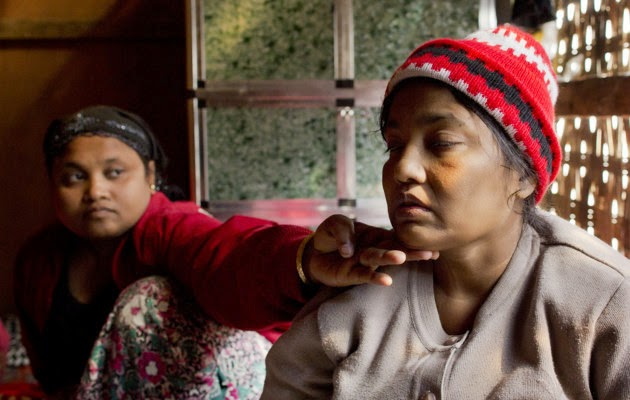
Inter-ethnic violence continues up till today in Myanmar. In 1982, the ruling junta enacted a law that barred "non-indigenous" residents from holding public office, As I was just beginning to read the book, by sheer coincindence I saw this article in a list of articles on Yahoo's news feed. These are the faces of Rohingya people from Western Myanmar, Muslims and ethnically Indian, they have been branded as Bengali illegal immigrants, though their families have lived in Myanmar for generations. They have been the victims of political disenfranchisement and mob violence over the past few years. Hundreds of thousands of Rohingya are now living in refugee camps in Bangladesh, Thailand, and Malaysia.


Wednesday, February 26, 2014

Saturday, March 1, 2014, 2:00 PM, San Leandro Main Library

Quiet: The Power of Introverts in a World That Can't Stop Talking by Susan Cain

Susan Cain was born in 1968 and attended Princeton University and Harvard Law School. She worked as a corporate lawyer and a negotiations consultant before withdrawing from the corporate world to become a full-time homemaker, writer, and public speaker. She maintains a website about her past work and ongoing work for the "Quiet Revolution. She also has a blog with an associated forum that you can join to read about and discuss topics dear to the hearts of introverts. I was first introduced to the ideas of Susan Cain by a friend who pointed me to the TED Talk that Ms. Cain references in the book.


Introvert versus Extrovert

At her website, Susan Cain has posted a link to an online version of the introvert/extrovert quiz that she included in Quiet. However, I thought that quiz was a little too polarized, so I found one I thought was more nuanced in an article on About.com. The article also contains links to other topics about introversion and extraversion, personality type, etc.

Open-Office Floor Plans

It just so happens that right about the time that a good friend of mine was mourning a move by her company from a semi-enclosed work space—with cubicles and small offices—to a completely open floor plan, I came across this article in The New Yorker about the hazards of open offices spaces. Since Susan Cain also mentions open floor plans as a contributor to "groupthink," I thought you might be interested in that article.

Wednesday, January 29, 2014

Saturday, February 1, 2014, 2:00 PM, San Leandro Main Library

The Big Read 2014

Maharaja's turban ornament.
Last Saturday, January 25, 2014, the San Leandro Main Library hosted "Passport to India," the kickoff event for this year's Big Read. We were treated to a slide show about the influence of the maharajas in India's art and culture, which was presented by Kalpana Desai from the Asian Art Museum in San Francisco. The presentation was followed by samples of traditional Indian sweets and savory snacks and a display of typical spices of Indian cuisine courtesy of Santos Spice Products of San Leandro. There were also demonstrations of henna tattooing, of sari tying, and of the board game Pachisi, the national board game of India. More news about this year's events can be found at the Big Read Blog.


The Namesake by Jhumpa Lahiri

Saturday's Readers Roundtable group will be the first of the book discussion groups for this year's Big Read selection, The Namesake by Jhumpa Lahiri.This is the story of a first-generation Bengali immigrant family and was also the selection of the month for the Readers Roundtable in May of 2005. The handout material for the Big Read references a 2003 "Fresh Air" interview with Jhumpa Lahiri, which can be found here.

The Namesake was also made into a movie in 2006, directed by Mira Nair and starring Kal Penn (born Kalpen Suresh Modi), who also starred as "Kumar" in the "Harold and Kumar" movies and as "Dr. Lawrence Kutner," for two seasons of the television series "House."


Other Books about the Immigrant Experience

In the United States, one of the recurrent themes of popular literature is that of the struggles of immigrants and their children. The two I remember best were recommended to me by my mother.
  • Anything Can Happen by George and Helen Papashvili: The very funny semi-autobiographical account of the adventures of a young Georgian immigrant who arrives in the US following his service in the Tsar's army during World War I.
  • Mama's Bank Account by Kathryn Forbes: This account of growing up within the Norwegian community of San Francisco formed the basis for the movie "I Remember Mama."
I vaguely remember a book I read as a teenager about a family of three sisters from one of the Baltic states who find themselves in the US as "displaced persons" following World War II, but I don't remember the title, and Google isn't helping me.

You probably have your own favorites, and your recommendations will be welcome in the comments.

Of All Authors, Why Nikolai Gogol and "The Overcoat"?

Last week, Sherryl and I listened to a recording of "The Overcoat," the short story by Nikolai Gogol that Ashoke Ganguli was reading at the time of his train accident. You can find the recording on YouTube in two parts, Part 1 and Part 2. It is also available in a PDF version from Project Gutenberg. We were struck by the part beginning in the third paragraph when Gogol explains how his ill-fated protagonist received his bizarre name.
His family name was Bashmatchkin. This name is evidently derived from “bashmak” (shoe); but when, at what time, and in what manner, is not known. His father and grandfather, and all the Bashmatchkins, always wore boots, which only had new heels two or three times a year. His name was Akakiy Akakievitch. It may strike the reader as rather singular and far-fetched, but he may rest assured that it was by no means far-fetched, and that the circumstances were such that it would have been impossible to give him any other.
This is how it came about.
Akakiy Akakievitch was born, if my memory fails me not, in the evening of the 23rd of March. His mother, the wife of a Government official and a very fine woman, made all due arrangements for having the child baptised. She was lying on the bed opposite the door; on her right stood the godfather, Ivan Ivanovitch Eroshkin, a most estimable man, who served as presiding officer of the senate, while the godmother, Anna Semenovna Byelobrushkova, the wife of an officer of the quarter, and a woman of rare virtues. They offered the mother her choice of three names, Mokiya, Sossiya, or that the child should be called after the martyr Khozdazat. “No,” said the good woman, “all those names are poor.” In order to please her, they opened the calendar to another place; three more names appeared, Triphiliy, Dula, and Varakhasiy. “This is a judgment,” said the old woman. “What names! I truly never heard the like. Varada or Varukh might have been borne, but not Triphiliy and Varakhasiy!” They turned to another page and found Pavsikakhiy and Vakhtisiy. “Now I see,” said the old woman, “that it is plainly fate. And since such is the case, it will be better to name him after his father. His father’s name was Akakiy, so let his son’s be Akakiy too.” In this manner he became Akakiy Akakievitch. They christened the child, whereat he wept and made a grimace, as though he foresaw that he was to be a titular councillor.
"The Overcoat," Russian commemorative stamp.